
2 Apr 2026
Last week, the Financial Times broke the news that the Thames Water creditors are closing in on a deal to take control of the utility, and keep it out of Special Administration.
Under the terms of the proposal, Thames Water’s fines from Ofwat would be waived until 2030, and their pollution and performance targets suspended or “significantly modified”.
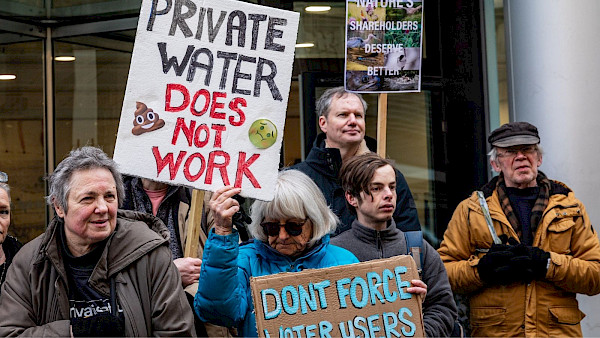
Thames Water's creditors want a holiday from the rules, and they want us to pick up the bill.
Thank you, for taking action an emailing your MP to get them to sign our open letter to Ofwat and Environment Secretary Emma Reynolds, demanding that this deal gets rejected.
If you've haven't emailed your MP yet, take 2 mins to write to them now:
If you get a response back from your MP without a committment to sign, we're encouraging you to respond to them.
Thanks to brilliant We Own It supporters, we've seen many MPs' responses, refusing to sign our open letter, and outlining their reasons why.
One thing is very clear: MPs don't have all of the information on water. We need you to give it to them.
We've compiled some of the common arguments from MPs, and written out suggested responses that give them the facts about Thames Water; the privatised water scandal; and the shocking inadequacy of government's response so far.
Copy, paste, edit and send back to your MP!
“... tougher regulation will solve the problem …”
-
This deal is the opposite of toughened regulation. It will set a dangerous new low for every single water company in England. If they accept, this government will send a clear signal to all other water companies that their failure will be rewarded with regulatory leniency.
-
As Water Minister Emma Hardy remarked in February 2024: “Unless owners and shareholders believe that there is a genuine risk of them losing their licence, they have no real incentive to promote good corporate behaviour or environmental performance”
“...I supported the landmark Water (Special Measures) Act 2025…”
-
In February 2025 - under the Water Special Measures Act - this government banned water bosses’ bonuses and introduced measures to bring criminal charges against persistent offenders. Since then, Thames Water has paid out over £2m in bonuses through a ‘Management Retention Plan’, and not a single chief executive has been charged with an offence - despite water companies accumulating nearly 1200 criminal convictions.
- In May, it was revealed that the Environment Agency has not completed any prosecutions against water companies for sewage dumping committed in the past 5 years
- At the beginning of 2026, sewage pollution in London and the South East hit record levels. Regulation is failing.
“... I welcome the Government’s new White Paper on water reform and the Clean Water Bill…”
-
The New Vision for Water White Paper, and subsequent Clean Water Bill, is a gift to privatised water. A new, single regulator will be ripe for corporate capture. A ‘tailored approach’ for each water company and ‘constrained discretion’ offer water companies even more scope to bend and break the rules without consequence.
-
It is unsurprising that water lobbyist body Water UK has welcomed the new white paper with open arms, especially given that DEFRA chose to shape new legislation around their priorities.
“...Ofwat will only agree to a plan with creditors if it will ensure the best possible outcomes for customers and the environment…”
-
This deal does not ensure the best outcomes for the environment: Thames Water’s creditors want to dodge pollution fines until 2030, and suspend or modify their pollution and performance targets. This can only mean even more destruction of our rivers and seas.
-
This deal does not ensure the best outcomes for customers: increased sewage pollution poses an even greater risk to public health. In the midst of a cost of living crisis, all households are being asked to pay more in return for significantly reduced commitments. On average, water bills are increasing 36% between 2025-2030. The average household water bill is now £639. This deal would not protect customers from even further price increases.
“... Thames Water is under a cash lock-up arrangement, which means they can’t pay out dividends to shareholders…”
-
This is true, but they are still on track to make huge profits from the sale of Thames Water
-
This deal would enable Thames Water’s creditors to sell off the company as soon as 2030
-
As part of the deal’s terms, there is an “excess value share mechanism from the proceeds of any eventual sale of the business”, which indicates the anticipation that a huge amount of profit will be extracted from the sale of the company. The proposal’s refusal to name an amount at which this mechanism would be triggered reveals the creditors’ determination to keep as much for themselves as possible.
"….Should Thames Water become insolvent, I know Ministers would not hesitate to apply to place the company into a special administration regime…"
-
Thames Water is in financial crisis. They have a debt pile of nearly £20 billion.
-
Thames Water have been in breach of their licence since July 2024, when their credit rating was slashed to ‘junk’.
-
Thames Water is not financially viable. No ordinary company operating under these terms would still be afloat. We cannot allow Thames Water to be impervious to failure at the increasing expense of billpayers.
“... public ownership of water would cost billions of pounds, and take money away from hospitals and schools…”
-
The government does not know how much public ownership of water would cost, because they have not attempted to calculate it.
-
The £100bn figure for nationalisation which government has previously quoted has been widely debunked, and was produced in a water-industry-funded report.
-
Research by Common Wealth has revealed that the cost of bringing failing water companies into public ownership could be as little as £0. Because they have extracted more than they have invested and run our water infrastructure into the ground, shareholders do not deserve compensation.
-
Water companies are sought after by investors because they offer a guaranteed income stream from billpayers. If nationalised, this would be a source of income for the Treasury.
“...it would take many years to unpick the current ownership model, taking time away from fixing the problems people care about…”
-
Regulation of water is simply a sticking plaster, and a failing one at that. The only effective fix is one which tackles the root cause: privatisation. Anything else is simply kicking the can down the road.
-
Last year, this government passed emergency legislation to protect British Steel. It is now on track to be nationalised within weeks. We can and must do the same for water.
“...Scottish water is nationalised, but they still face lots of problems…”
-
On average the annual water bill in Scotland is £107 cheaper than in England.
-
Elsewhere, the customer satisfaction rate for publicly owned Eau de Paris ranges from 90-96%, and the best bathing sites in Europe are all where water is publicly owned.
-
Last year, the Office for Statistics Regulation stated that former Environment Secretary Steve Reed risked misleading the public over his claims that Scotland’s water is more polluted than England’s.
“... Nationalising now would let shareholders off the hook…”
-
No, it wouldn’t. Bringing failing water companies into public ownership with little or no compensation for shareholders is an appropriate consequence. This would also make public ownership affordable.
Comments
Kerrie-Ann 6 months ago
Take back the power and stop lining the pockets of greedy fat cats!
Reply
Peter Addis 6 months ago
Let's clean up our rivers as a priority.We must be responsible for our environmental and not private businesses.
Reply
Pete Sear 6 months ago
This is only RIGHT
Reply