
Campaigners call for end to care profits as poll shows support for action
28 Oct 2026
Source: www.cypnow.co.uk

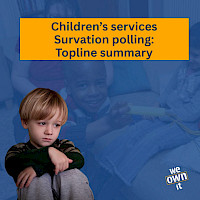
In October 2026 we published new polling on the public’s views about profiteering in children’s social care.
Our polling, commissioned from Survation, was conducted at the end of September among 1,066 people in Great Britain. It shows that:
Nearly 80% of those with a view say government should cap or end profits in children’s social care
Of those who expressed a view, 50% supported the statement that “England should go further and work towards ending profit-making provision in children's social care altogether”.
There are just over 100,000 looked-after children in England, Scotland and Wales. Most are in foster care, with a smaller proportion in residential care settings including children’s homes, secure children’s homes, independent or semi-independent living facilities and residential schools.
Historically, children’s social care was largely provided either directly by local authorities using their own in-house provision, or by third-sector organisations working in partnership with the local authority. Over the past few decades, many local authorities and charities have reduced or ended provision of their own children’s homes; today, at least one in three fostering agency placements and one in five children’s homes placements are run by firms backed by institutional finance — private equity, hedge funds, venture capital and sovereign wealth funds.
"Both Conservative and Labour governments have encouraged councils to outsource services, and the care of vulnerable children has been treated in much the same way as road maintenance and waste disposal, ostensibly cheaper and more efficient in private hands...In my opinion, local authorities should never have been allowed to abrogate their responsibility to the children and young people in their care by passing them on to private companies." Martin Barrow, journalist and local authority foster carer
85% of children’s homes are privately-owned and mostly run for profit. 11 of the 20 largest providers of children’s social care, which includes fostering, children’s homes and other services such as residential school places, now have some kind of private equity involvement.
“I see what is happening to children like me now and it’s not good, it’s not necessary, and it shouldn’t be happening – that’s what really fires me up still.” Ray Jones, Professor of Social Work at Kingston University
The Competition and Markets Authority says the market in children's social care is not working, and that the "UK has 'sleepwalked' into a system in which children are failing to get suitable placements in foster care and children’s homes". They highlight three issues in particular - high profits, high levels of debt and the risk of companies collapsing.
But private sector provision of children's social care is not only bad value for money. It also delivers a worse service for the most vulnerable kids in society. This affects their futures. Private companies - often private equity - are incentivised to cut corners rather than provide the care these children need.
Research by Oxford University published in the Lancet found that “All for-profit homes [are] disproportionately located in areas of low need and investment-owned homes located more in areas with low house prices". It concluded that "The commercialisation of children's social care provision has corresponded with less accessible services, contributing to sufficiency issues.”
A recent article in the Financial Times made clear the stark consequence of this strategy: "Half of children are now sent to institutions more than 200 miles away from their families, according to government data. One in seven move home three times a year or more."
"Gaps in provision mean children are placed in homes far away from their families. They lose touch with their friends and might have to change schools. It might be harder for their social worker to stay in touch or for their family to visit. On average, this is a bad thing for a child…The profit motive – which we think is strongest in the investment-owned children's homes – has a role in creating a market which doesn't respond to the needs of children."
Dr Benjamin Goodair, British Academy Postdoctoral Fellow, Centre for Analysis of Social Exclusion (CASE)
Wales is phasing out profits in children’s social care, while Scotland is capping profits on homes and removing profits from foster care. We Own It is calling for the Children's Minister, Josh McCallister, to copy these examples and ban profit from the sector in England. We also encourage the government to set up a publicly owned provider in the sector as a backstop and to increase resilience.