
Analysis News Private Providers privatisation 8 out of 20: Burnham inherits a health plan built on private sector delivery
3 Aug 2026
Source: lowdownnhs.info

The founding principles of our NHS are that it is free at the point of use, funded through general taxation, publicly provided and available to all.
If you get ill, have an accident, need an operation, or have a baby – the NHS is there for you.
Since the NHS was founded in 1948, it has been proven to be one of the best and most efficient healthcare systems in the world – and unlike many others, it remains free at the point of delivery. The NHS was ranked the best healthcare system in the world according to a 2014 Commonwealth Fund study, and the second cheapest of those analysed.
But recent governments have threatened the healthcare we all have access to, with cuts, privatisation and new PFI.
In 1990, the “purchaser-provider” split was introduced, as well as an internal market within the NHS. This separated the job of providing care from that of commissioning care. Initially, NHS Trusts were created to serve as the main providers, but more recent legislation opened the door wider to private companies being used to provide NHS services.
The 2012 Health and Social Care Act opened the door to rampant privatisation by requiring a competitive tendering process, involving for-profit private companies, for all NHS contracts over a certain value.
The 2022 Health and Care Act recognised the failure of that model. Section 75, the part of the 2012 Act responsible for the explosion of outsourcing, was revoked. However, the 2022 Act still opened the door to private companies having seats on NHS decision-making bodies and being given NHS contracts without public scrutiny.
The vast majority of the NHS is still publicly owned and run. However, since the passing of the 2012 Health and Social Care Act, it is clear that there has been a trend in the direction of private healthcare companies running more NHS services.
As of 2021, almost 10% of the NHS’s budget, by Labour’s estimate, over £100 billion, was spent with for-profit private companies. Within this figure, NHS trusts and foundation trusts' spending with Independent Sector Providers, including private for-profit (albeit not them exclusively), exploded by 559% in the decade to 2020 - 2021, according to the BMA. More recent analyses are not available, but the use of private hospitals to treat NHS patients, especially for hip, knee, hernia and cataract surgeries, has been expanded since the pandemic.
In January 2025, the Labour government struck a deal with the Independent Healthcare Providers Network, which would see private providers given long-term NHS contracts, embedding them within the NHS. This deal would see private hospitals suggested to patients as options for where they can get treatment, alongside NHS facilities.
NHS Trusts continue to pay for historic debts accrued because of Private Finance Initiatives (PFI). PFI was a policy of contracting private companies to build NHS hospitals at their own expense, with the NHS paying those companies back at rates much higher than they spent building the hospitals (plus interest) in yearly instalments. Recent We Own It research has found that despite already paying back more than three and half times what was borrowed, NHS Trusts still owe more than £44 billion on PFI debts.
In the Autumn 2025 Budget, the government announced that they are introducing a new form of private finance in our NHS to build Neighbourhood Health Centres. The details of this new finance arrangement have not been shared with the public or MPs. Ministers have claimed that they will learn from the mistakes about PFI, but this promise has been made time and time again - PF2, LIFT, the Scottish Non-Profit Distributing model and the Welsh Mutual Investment Model have all been introduced as improved models of PFI. They have all failed taxpayers and patients.
Read the briefing: Private Finance in the NHS
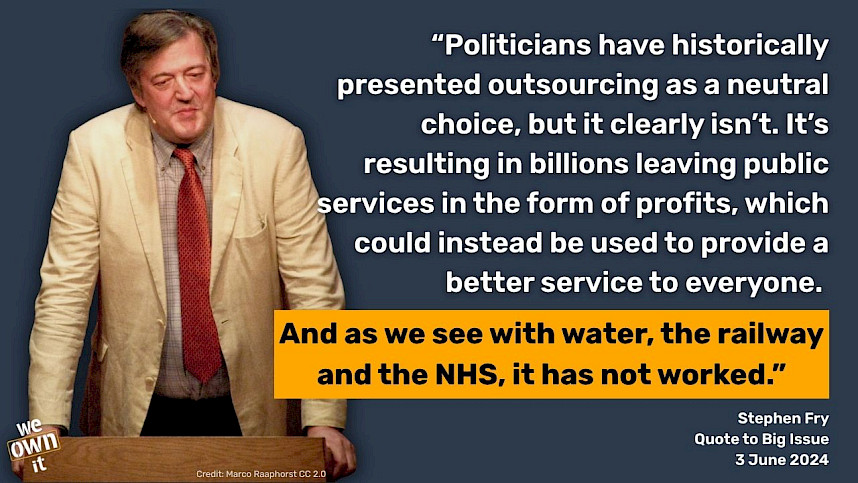
NHS waiting lists currently stand at 7.33 million people. The government supports a policy of sending NHS patients to private hospitals for elective operations like cataracts, knees, hips and hernia, to bring waiting lists down. This outsourcing is sucking billions out of our NHS in profit, which could be used to treat patients. For example, research from the Centre for Health and the Public Interest shows that private providers of cataract surgeries have an average profit margin of 32%.
Furthermore, Private hospitals will not the help fix the waiting list crisis, because Only the NHS:
The real solution is to invest directly in the NHS to build up its capacity so that it can treat all patients.
We Own It has been campaigning for investment to rebuild the NHS and end the outsourcing of NHS surgery to private hospitals