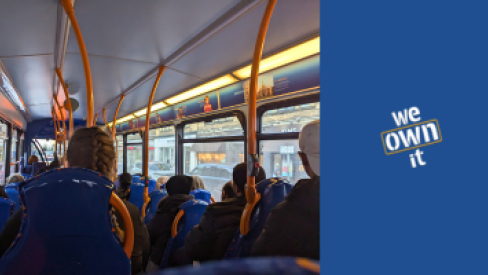
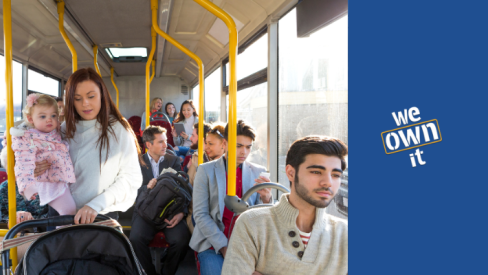
Do you take the bus to get to work, to the shops, or to visit friends and family? Many of us do. Buses keep our cities moving and our countryside accessible to everyone.
Yet since privatisation in the 1980s fares have gone up and thousands of bus routes have been cut, leaving passengers stranded. We need public ownership.
There are already ten publicly owned municipal bus companies in the UK doing fantastic work.* Public ownership would save us £506 million a year that could be invested in developing better bus networks and lower fares for you. Those savings could even pay for 1,356 new electric buses.
Key Facts
- Buses remain the most-used form of public transport in England. We need them, and we rely on them. They provide a vital link for communities, and groups whose access to public services has been cut.
- Women make a third more bus journeys than men, and more often make care-related trips that are badly served by bus systems designed for commuters.
- Meanwhile, young people (aged between 17 to 20) ride buses more regularly than anyone else – mostly because two thirds of them don't have access to a car.
- low-income households are two and a half times more likely to use buses than wealthier counterparts, while bus provision in more deprived areas has been cut hardest.
- Disabled people are 20% more likely to use the bus than the general population.
- The National Audit Office recently found that half of all bus operator income now comes from public subsidy, worth £1.8bn in 2023-24.
- Public ownership would save us £506 million a year that could be invested in developing better bus networks and lower fares for you. Those savings could even pay for 1,356 new electric buses.
Fares are more expensive!
- Bus fares have risen over 500% since 1987, versus 397% for rail and just 246% for motoring.
- Only 1% of bus services face head-to-head competition, which a 2011 Competition Commission report has shown has led to lower quality services and higher fares. This report also notes how customers get on the first bus that comes along - of course they do! Bus services are natural monopolies that should be run as an integrated network, not a competitive market.
- Bus trips outside of London have halved since the privatisation of our buses.
Privatisation fails the planet!
- In the decade to 2019, well over 3,000 bus routes were cut.
- 57% of motorists would use their car less if bus fares were lower, and services more reliable.
Privatisation fails the public!
- We lost £1.49 billion to shareholders in the ten years to 2019 due to privatisation.
- 19% of workers have had to turn down a job due to poor quality bus services.
- 56% of small rural towns in North East and South West of England have become transport deserts or are at risk of becoming one.
- Countries such as Germany and Switzerland have invested in their public transport network with impressive results: integrated systems in public control means bus services can be available for every village, every hour.
Public ownership is better for passenger, public, and planet!
- Transport accounts for 26% of UK emissions, and pollution from cars and vans costs the NHS around £6bn a year.
- As the Campaign for Better Transport notes, more bus use would cut those emissions – especially since the Bus Services Act bans new non-electric buses from 2030.
- Fuel duty freezes have cost the Treasury £133bn since 2011 – money that could have transformed the bus network, and a lot more besides.
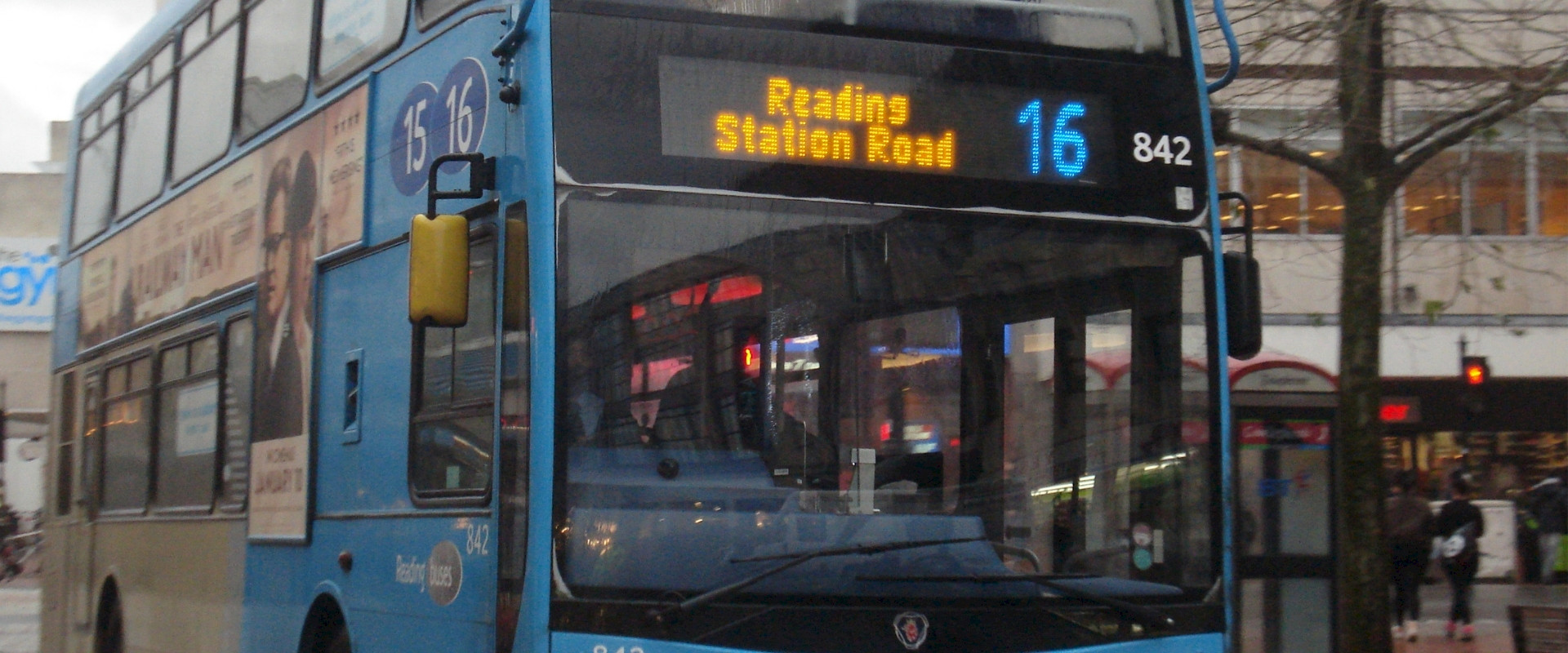
- As a municipally owned bus service, Reading Buses can invest an additional £3 million a year in the bus network (around 12-15% of its annual turnover) because it doesn't pay out dividends to private shareholders. The extra money means better quality buses, one of the greenest fleets in the UK, and contributes to more people taking the bus in Reading.
- Publicly owned bus companies have won the annual UK Bus Operator of the Year Award for 5 of the last 7 years, including the last two awards going to Nottingham in 2019 and Blackpool in 2022.
- The UK’s largest public bus company, Lothian Buses, operates 70 routes in Edinburgh and the surrounding area. Levels of customer satisfaction for Lothian Buses are the highest in the industry and it returned £5.5 million to the public purse.
The history
From 1930 to 1980 governments regulated bus services in the public interest, with Traffic Commissioners controlling the quality and quantity. Most services were delivered directly through publicly owned bus companies, often run by councils.
Thatcher’s 1985 Transport Act deregulated services outside London and led to the mass sale of council bus companies. The result is a wild west free market where a few private operators set fares, routes, timetables and standards without public oversight.
While councils can still buy existing operators, the Bus Service Act 2017 banned councils from setting up bus companies ‘from scratch,' something Scotland and Wales have overturned. It also allowed devolved English regions to re-regulate their services and bring them into London-style public control (or franchising).
Victory for We Own It!
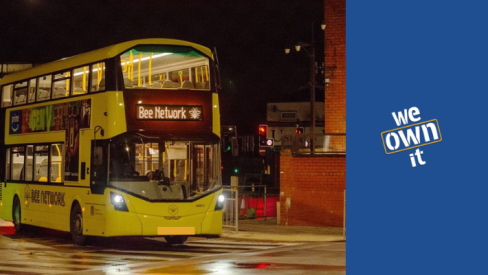
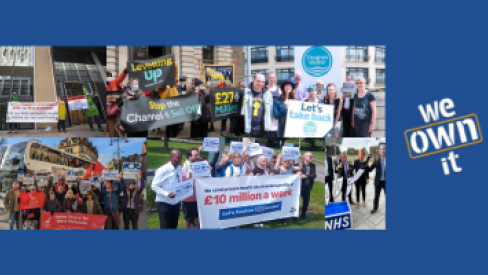
In March 2021, following a We Own It campaign, the Mayor of Greater Manchester, Andy Burnham, decided to bring the region’s buses back into public control starting in September 2023: the first area to regulate services in over four decades.
You've led successful campaigns to get other areas to take back control of buses, with Liverpool confirming a move to re-regulation in October 2023 and West Yorkshire joining the group in March 2024.
You've also supported moves towards public control in South Yorkshire and the West of England, while ACORN and Get Glasgow Moving are winning victories elsewhere.
Who owns your buses?
There are over a thousand bus companies in the UK, but the market is dominated by just five private bus companies that carry 70% of passengers. But who owns the ‘Big 5’ bus companies?
- Arriva is owned by 'I Squared,' a private equity firm registered in the Cayman Islands, after being sold by the publicly-owned German transport company Deutsche Bahn.
- First is floated on the stock market but is dominated by three big asset management firms: Coastal Capital Management, Saint James Place PLC, and Schroders PLC.
- Go-Ahead is mostly owned by a consortium of Kinetic Holding, an Australian bus company, and Globalvia Inversiones, a Spanish Transport Infrastructure Company.
- National Express is floated on the stock market but is dominated by banks, like JP Morgan Chase and Bank of New York Mellon Corp, the Lion Trust asset management firm, and Jorge Cosmen, a high net worth individual.
- Stagecoach is owned by DWS Infrastructure, itself mostly owned by Deutsche Bank.
A small number of municipal bus companies, owned by their area's local councils, have survived privatisation and deregulation:
- five in England — Blackpool, Ipswich, Nottingham, Reading, and Warrington.
- two in Scotland — Dumfries and Galloway and Lothian in Edinburgh.
- two in Wales — Newport and Cardiff.
- nearly all of Northern Ireland’s buses are operated by Translink, a Stormont government-owned transport company.
FAQs
What is public control of buses? How is it different to public ownership?
Taking buses into public control is also sometimes called re-regulation or bus franchising. It is a specific legal power outlined in the Bus Services Act 2017. It ends the deregulated, wild west free market of Thatcher's 1985 Transport Act.
Public control means that the entire bus network is regulated by a local authority, rather than having decisions in the hands of individual private operators. The network is designed, integrated, and coordinated by a public body. Tickets work across all operators. Employment, environmental, and accessibility standards are universal: even the colour of the buses can be set in common!
Only operators who win a contact specifying fares, routes, timetables, and standards are allowed to operate services in the publicly controlled area. Any money they make through selling fares goes directly to the local authority. Operators bid in to run services and the lowest or best bid receives the contract. They receive a contract management fee. Contracts allow local authority to fine or ban poorly behaving operators and to give rewards when they do well.
Unlike public ownership, some of the operators that win contracts may be privately owned. Their contract management feel will include a profit, meaning that some money leaks out of the system.
Can my council take its buses into public control?
The Bus Services Act 2017 gave all Mayoral Authorities the automatic power to franchise bus services, provided they unlocked the powers through a pre-franchising process.
The pre-franchising process requires an extensive business case, independent audit, and three-month public consultation. After this the Mayor can decide to implement franchising.
Other Local Authorities cannot automatically start the pre-franchising process. They must first request the powers from the Secretary of State for Transport, convincing the Government they have the capacity to run the assessment and deliver public control.
There are exceptions. Cornwall does not currently have a Mayor, but does have the power to start the pre-franchise process. Similarly, North Tyneside currently has a Mayor, but cannot start the pre-franchising process. This will change after May 2024 when a new Mayor for the entire North East will be elected.
[Labour has committed to widen the powers to give automatic franchising powers to all Local Authorities and to simplify the process.]
Can my council set up a publicly owned bus company?
The Bus Service Act 2017 banned councils from setting up ‘from scratch’ bus companies. However, it also clarified how areas with devolution deals can re-regulate their services and bring in London-style public control (or franchising). A 2016 Transport Committee report supported the right of local authorities to establish new municipal bus companies.
In March 2021, the Government released a National Bus Strategy. The report clarified that councils can buy existing bus companies — a power used by Pembrokeshire Council in January 2022 — and that the ban on ‘from scratch’ municipals is “ripe for review.”
Scotland has lifted the ban on municipal ownership while the Welsh Government has announced plans to do the same.
[Labour has committed to lift the ban on new municipal or council owned bus companies for all of England.]
Who is against privatisation and deregulation?
The public aren't in favour of handing over our buses to private companies.
- Nationally, nearly three quarters want public transport to be mostly public sector run.
- Bringing buses and trains into public ownership, one way of describing a fully public transportation, is supported by nearly two-thirds of people nationally (10% oppose).
- In city regions, up to 76% of residents support buses in public control (5% oppose).
Experts show that public control is quantifiably better for passengers than private control.
- Centre for Cities. While all 23 “key mayoral aspirations for bus services” can be delivered by a franchising system but only 5 under an Enhanced Partnership.
- Transport for a Quality Life. Deregulation stops our bus networks from achieving 13 out of the 16 essential attributes of a world-class bus system. All 16 essential attributes of a 'World-Class Bus System' are delivered by franchising.
- The Government believes 6 of 7 Local Transport Authority objectives are better achieved by franchising than a partnership — they tie on the 7th objective.
- DLA Piper found that over a third of local targets are at risk under a partnership deal but that all targets would be secure under a franchising arrangement.
A wide range of think tanks and campaigners support taking buses into public control.
- The Institute for Public Policy Research. The ‘Greasing the Wheels’ concluded that bus deregulation outside of London has been a failure.
- Campaign for the Protection of Rural England. Germany and Switzerland bus networks are in public control under the “guiding mind of the local authority” allowing bus services that reach every village, every hour.
- CommonWealth
- Yorkshire & the Humber Pensioners Convention
- Leeds Civic Trust
- Centre for Human Rights and Global Justice and former UN Special Rapporteur on Extreme Poverty and Human Rights, Prof. Philip Alston.
- A 2016 Transport Committee report supported the right of local authorities to establish new municipal bus companies.
Get Involved
Communities everywhere need reliable, frequent and affordable buses. Here's how to get involved in:
- West Yorkshire! Sign the petition calling on Tracy Brabin, newly elected Mayor, to end the wild west free market!
- South Yorkshire! Sign the petition calling on Oliver Coppard to take back your buses!
- North Yorkshire! Sign the petition here.
- West of England! If you're in Bristol, Bath and North East Somerset, or South Gloucestershire, you can sign up to hear more here!
- Glasgow! Join the amazing Get Glasgow Moving campaign.
Related news
-
27 Apr 2026 Source: leftfootforward.org
-
How Manchester’s Bee Network is being replicated around the UK
- Media Mention
- Buses
29 May 2025 Source: www.ciht.org.uk -
South Yorkshire to take back control of buses
- Media Mention
- Buses
21 Mar 2025 Source: morningstaronline.co.uk -
'Back to the future' - South Yorkshire buses back under public control
- Media Mention
- Buses
19 Mar 2025 Source: www.yorkshirepost.co.uk -
South Yorkshire to go ahead with bus franchising after ‘overwhelming support’
- Media Mention
- Buses
11 Mar 2025 Source: hellorayo.co.uk