1 Oct 2026
Councils are beginning to bring children’s homes back in-house, showing how England could start reducing its dependence on the private market for children’s care.
Labour-led Reading Borough Council is opening three new council-run children’s homes, while Green Party-led Lewisham Council is preparing to open its first local authority-run children’s home in decades. Both councils say bringing provision in-house will help children stay closer to their families and communities while reducing reliance on expensive private placements.
The moves come as new research from Common Wealth has found that the average cost of a children’s home placement reached £404,000 a year in 2024/25, a 64% increase in real terms since 2016/17.
According to the Local Government Association, the 20 largest independent children’s social care providers made profits of more than £310 million in 2021/22, with profit margins of 19% on average.
The shortage of suitable local provision means many children are being placed away from their homes. In Lewisham, 51 children are currently in residential care, but only around a quarter remain within the borough when placed in care.
Lewisham Cllr Rotimi Skyers said residential placements cost the council almost £30 million a year, with some individual placements “exceeding £10,000 a week”. He added “I believe there are some responsibilities that firmly belong in the public realm; caring for our children who cannot live safely at home is one of them”.
The developments come as Andy Burnham has set out plans for a new National Care Service, saying that care should be “about people, not profit”. Campaigners say this wider reform provides an opportunity to rethink the role of profit in children’s care, rather than simply regulating the existing market.
The Government’s own language also points towards the need for a bigger change. Speaking at Labour Party Conference, Children’s Minister Josh MacAlister said the Government needs to “take back control of the care system” and “push out private equity and sovereign wealth funds” that are investing in the care system to get a financial return. That is a significant recognition of the role that financial investors now play in children’s social care. But if the Government wants to “take back control”, it also needs to be clear about what replaces a system that depends on private providers.
Reading and Lewisham are showing one part of the answer: councils can build and run their own children’s homes, keeping children closer to their families and communities while reducing dependence on private providers. The Government should support more councils to do the same and set out a clear, funded and time-bound pathway towards ending profit-making provision altogether.
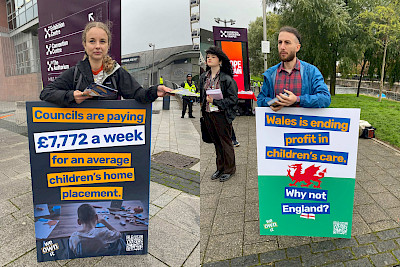
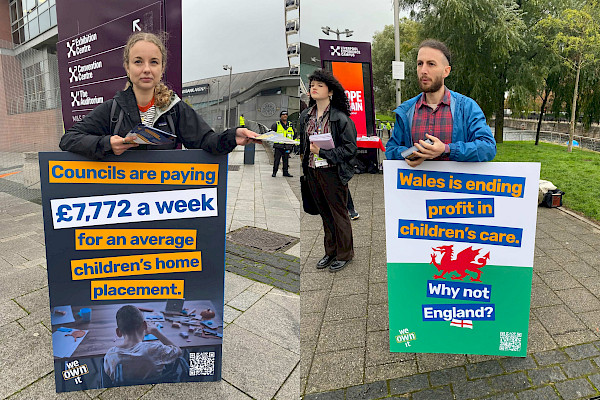
We Own It took the campaign to Labour Party Conference in Liverpool, where campaigners leafleted delegates and displayed boards highlighting the role of private profit in children’s social care and the alternative being developed in Wales. One board asked: “WALES IS ENDING PROFIT IN CHILDREN’S CARE. WHY NOT ENGLAND?”
The Government has introduced powers to cap the profits of private providers of children’s homes and fostering agencies, although the powers have not yet been used.
Wales has already begun moving towards ending profit in children’s care. Campaigners are calling on the Government to follow Wales and Scotland in setting out a clear pathway to end profit in children’s social care.
Jason Hussein, Lead Campaigner at We Own It, said:
“Children’s social care should be about children, not profit. Every child in care deserves a safe, stable home that puts their needs first, not a system designed to generate returns for private companies and investors.
Councils shouldn’t have to depend on the private market to find homes for children in their care. We’re paying an outsourcing premium: The average cost of a children’s home placement has now reached £404,000 a year.
“And the cost isn’t just financial. When councils can’t find the right provision locally, children can end up living miles from their families, friends, schools and support networks.
Reading and Lewisham are showing that there is another way. Councils can build and run their own homes, keep children closer to their families and communities, and reduce their dependence on private providers.
“But this needs to be part of something bigger. With 85% of children’s homes now privately owned, this Government must go further than profit capping. It should set out a clear pathway to ending profit-making provision altogether, so that public money is spent on caring for children, not generating returns for private companies and investors.”