15 Jul 2026
On 1 July The Guardian published an article by their financial editor, Nils Pratley. In its original form - corrected a day later - it described Welsh Water as being in public ownership. Here's the text of our letter to The Guardian pointing out this error and other inaccuracies.
Dear Sirs
Nils Pratley’s recent analysis (1st July “‘Complicated and expensive’: Burnham is right about the risks of nationalisation”) unfortunately needs correcting on many fronts.
Welsh Water is not in public ownership so it cannot be framed as an example. It’s an unaccountable not-for-profit with a self-selecting board of directors and it loses 41% of bills to finance costs, the same as Thames Water. This compares badly with truly publicly owned Scottish Water which has finance costs of only 8%, and 50% more investment than England and Wales.
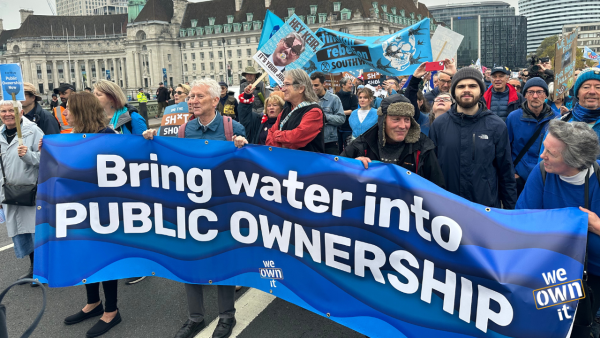
Pratley suggests Burnham could introduce greater public control, which he defines as the involvement of local politicians on the boards of privatised water companies, and he pits this against the bogeyman ‘nationalisation’. But as advocates of genuine public ownership, we are calling for local public ownership that does indeed include local politicians, but also puts households, workers and anti sewage groups on the board - more true accountability than what is being proposed here.
The piece mentions the conclusions of the Cunliffe report as though this is uncontroversial. Astonishingly, the government instructed Sir Jon Cunliffe not to consider public ownership in his supposedly independent review of the water sector. This was at a time when Lord Mandelson was deeply involved in government and the company he co-founded, Global Counsel, was lobbying for the privatised industry. Cunliffe's report fails to mention research from the US and France showing clearly the higher cost of privatisation for bill payers, and it ignores the evidence that the cleanest rivers in Europe are found where there is the most public ownership.
Pratley tries to argue that Thames Water is a one off case that can be treated in isolation. No doubt the industry would appreciate that but Thames is just the tip of the iceberg. All the privatised water companies are up to their eyeballs in debt and they have all been extracting billions from the system at the expense of households.
Taking back these companies and their assets is highly affordable through a proper application of the law. An Andy Burnham government must hold them truly accountable for delivering what they should have, saying no to requests for bill increases and leniency, forcing investment and putting previous neglect of the infrastructure on balance sheets as liabilities. This appropriately aggressive approach would reduce the profitability of these companies.
When they go bust or fail to fulfil their statutory duties, the special administration regime is there to protect the public interest and can be used to take them into permanent public ownership, without compensating shareholders for their failure. Debts will receive a haircut and be refinanced more cheaply in the public sector so that households aren’t paying a third of their water bills on debt and dividends.
Pratley also needs to check his figures. Based on the available information, the National Grid transmission network and the largest electricity distribution company combined are only worth £34 billion, almost half of the figure he gave, and as above, legislation exists for the energy sector too, to protect the public interest.
Privatisation is a 40 year rip-off that has been propped up by our bills and by myths like those in this piece. Burnham does not need excuses not to act, particularly inaccurate ones, he needs to be pushed to stand up for English households instead of prioritising shareholders on the other side of the world.
David Hall, Visiting Professor at Public Services International Research Unit, University of Greenwich
Cat Hobbs, Director of We Own It