15 Apr 2026
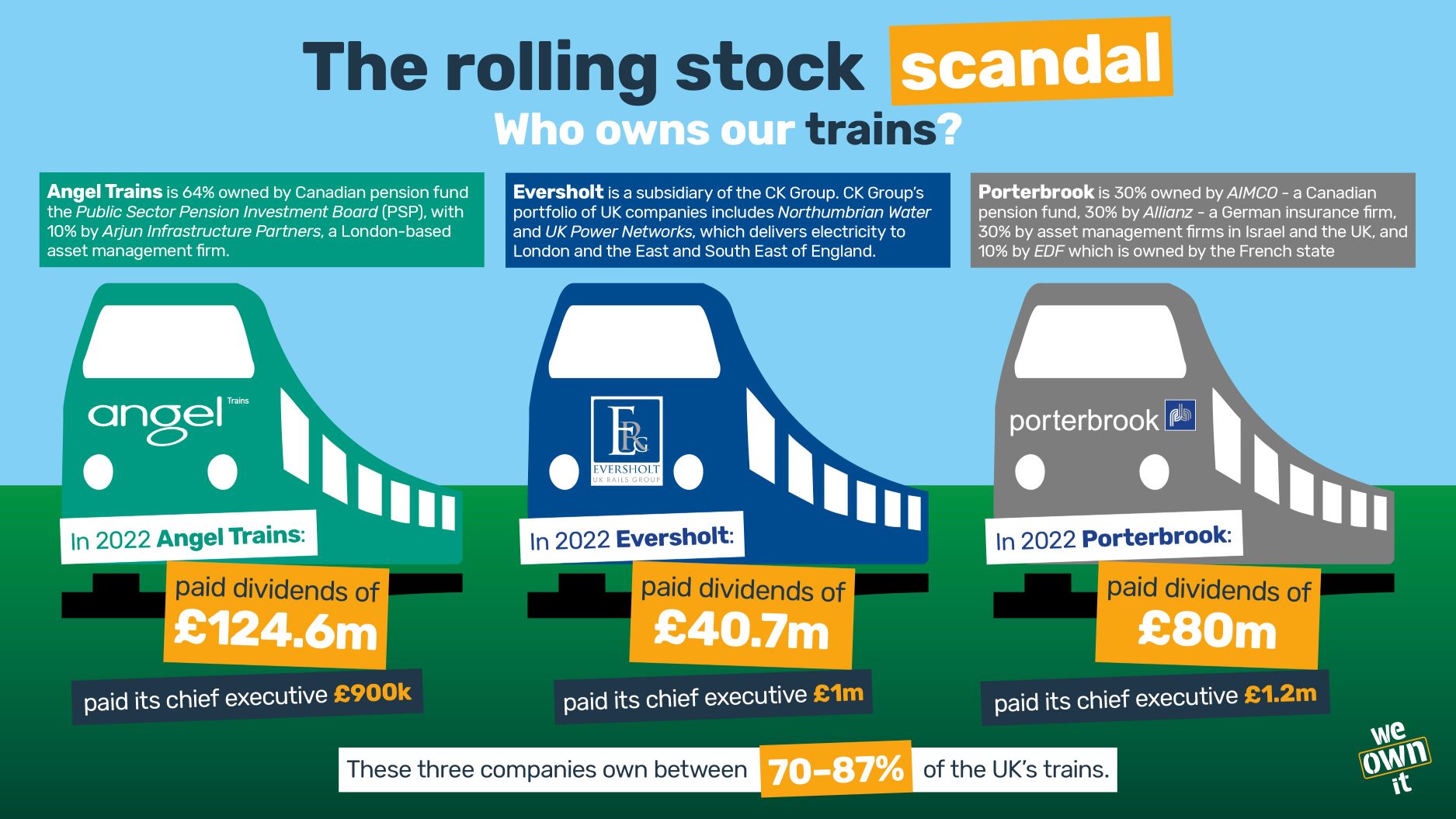
Today we have published research showing that dividends paid to shareholders by train leasing companies since the end of the pandemic could have cut regulated rail fares by up to 12.6% over the last three years.
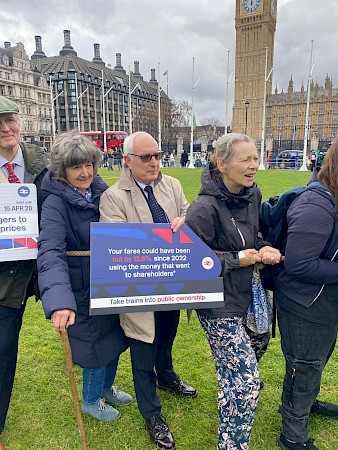
Our analysis comes as supporters, MPs, and our fellow campaigning organisations Bring Back British Rail and the Association of British Commuters prepare to stage a tug of war in Parliament Square, in a bid to draw attention to the failure of government rail legislation to put passengers first.
The government’s Railways Bill, which is awaiting Report Stage, is expected back in parliament within days - possibly as soon as Monday, 20th April.
MPs should amend the bill to make sure it:
-
Ends the privatisation of rolling stock and closes other privatisation loopholes in the bill
-
Prioritises new public missions for Great British Railways to deliver for the public, the environment and the economy, rather than 1990s competition law
-
Gives passengers rights and accountability, including giving passengers a seat on the GBR board.
Our analysis suggests that annual season ticket holders would have saved £750 a year travelling from Cambridge to London, £536.76 travelling from Woking to London and £357.84 from Liverpool to Manchester.
The train leasing industry is dominated by three companies: Angel Trains, who have paid out £1.9 billion in dividends to shareholders over the last decade; Porterbrook who paid out £1.15 billion and Eversholt who paid out £373 million, also over the last decade.
It's a Tug of War
Our tug of war had passengers on one side and private profiteers, including John Major and Richard Branson, on the other. Our message is that the government needs to pick a side. They can't run the railway as a mishmash - with profits flowing out and the private companies clinging on. After 30 years of failed privatisation, it's beyond time for a railway that is truly owned by the public. We are calling for publicly owned trains, a watchdog that is accountable to passengers, and public missions for the railway as the top priority, not competition law from the 1990s.
Chris Hinchliff MP has tabled an amendment to the bill, and attended the event. He said “Getting on a Great British Railways train must feel different from the rip-off, profiteering of years gone by. No more dirty carriages or late trains — passengers should come first.
“But most importantly, the first thing every GB Rail passenger should notice is a cheaper ticket. I’ve worked with We Own It on a plan to deliver lower fares for British residents, ensuring that nationalisation doesn’t just mean a new logo on the front of the train, but lower prices for the people who rely on it every day. Public ownership has to put more money in people's pockets.”
Neil Duncan-Jordan MP, who has also tabled an amendment to the bill, said “Labour has promised to take our railways into public ownership – most people would think this includes the trains we travel on.
“The Conservative privatisation disaster has cost families in endless fare rises, all while rolling stock companies pocketed hundreds of millions.
“The Railways Bill gives us a huge opportunity to put passengers first, but we can’t do it with half measures. The rolling stock companies are the elephant in the room of rail reform. I’ve worked with We Own It on a plan to bring these companies into public ownership so taxpayers and passengers are no longer ripped off.”
The research
According to the Office of Rail and Road’s 2025 Rail Industry Finance (UK), private rolling stock companies have paid out £1.16 billion in dividends since 2022/23.
Regulated fares are the types of fares which the government places guardrails around to prevent excessive increases. These typically include season tickets and some off-peak returns.
According to the Library of the House of Commons, and based on a response to a Written Question from DfT in November 2025, regulated fares make up around 30% of all fares.
Here are the figures for annual fare revenue in the UK railway over the relevant years:
£11.5 billion - 2024/25
£10.4 billion - 2023/2024
£8.6 billion - 2022/2023
Totalling: £30.5 billion
Under the assumption that 30% of all rail ticket revenue comes from regulated tickets, regulated fares revenue between 2022/23 and 2024/25 came to £9.15 billion.
What per cent of total regulated fares over the relevant years (£9.15 billion) could have been saved by passengers if rolling stock dividends over the same relevant period (2022/23 to 2024/25), £1.16 billion, were reinvested into cutting regulated fares?
This figure works out to 12.6% of regulated fares.
The following examples show current annual full season ticket prices on Trainline | Alternative prices with rolling stock public ownership | Savings
- Woking to London – £4260 | could be £3723.24 with rolling stock public ownership | customers save £536.76
- Gloucester to Birmingham – £5384 | could be £4706 with rolling stock public ownership - customers save £678
- Brighton to London – £5204 | could be £4548 with rolling stock public ownership | customers save £656
- Whitehaven to Carlisle – £2508 | could be £2192 with rolling stock public ownership | customers save £316
- York to Leeds – £2364 | could be £2066 with rolling stock public ownership | customers save £298
- Welwyn Garden City to London – £3836 | could be £3353 with rolling stock public ownership | customers save £483
- Liverpool to Manchester – £2840 - could be £2464 with rolling stock public ownership | customers save £357.84
- Cambridge to London – £5952 - could be £5202 with rolling stock public ownership | customers save £750
- Ipswich to Peterborough – £5628 - could be £4919 with rolling stock public ownership | customers save £709
- Bath Spa to Bristol Temple Meads – £2144 - could be £1874 with rolling stock public ownership | customers save £270
NB: Full annual season tickets are now under much less usage following changes to working patterns after the pandemic. However, as the above figures and savings illustrate, savings to other types of regulated fares, including flexi season tickets and off-peak return fares, would also be significant.
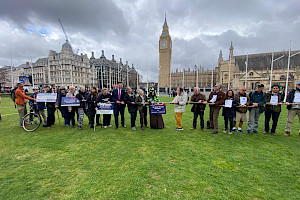
The Tug of War on Parliament Square. On one side of the tug of war: passengers, including commuters and leisure passengers, disabled passengers, rural passengers, older passengers, parents and grandparents with children plus the economy, nature and the environment (exciting costumes and signs welcome!) On the other side: private rail interests who are clinging onto our railway, including profit-making companies like First Group, and the private rolling stock outfits that own our trains, alongside John Major (the Prime Minister who privatised our railway).
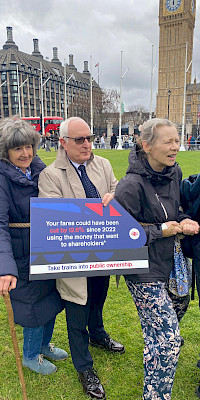
A close-up of the Passengers side of the Tug of War
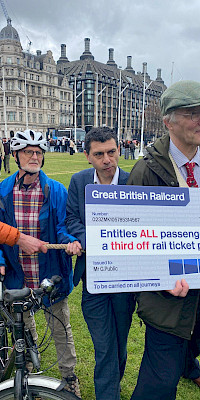
A rural commuter holds a placard, referring to MP Chris Hinchliff's tabled amendment to the Railways Bill.
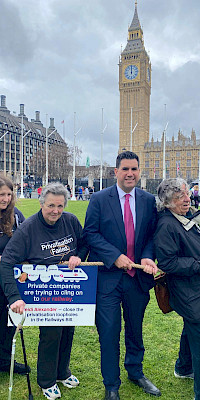
Richard Burgon MP about to take part in the Tug of War