
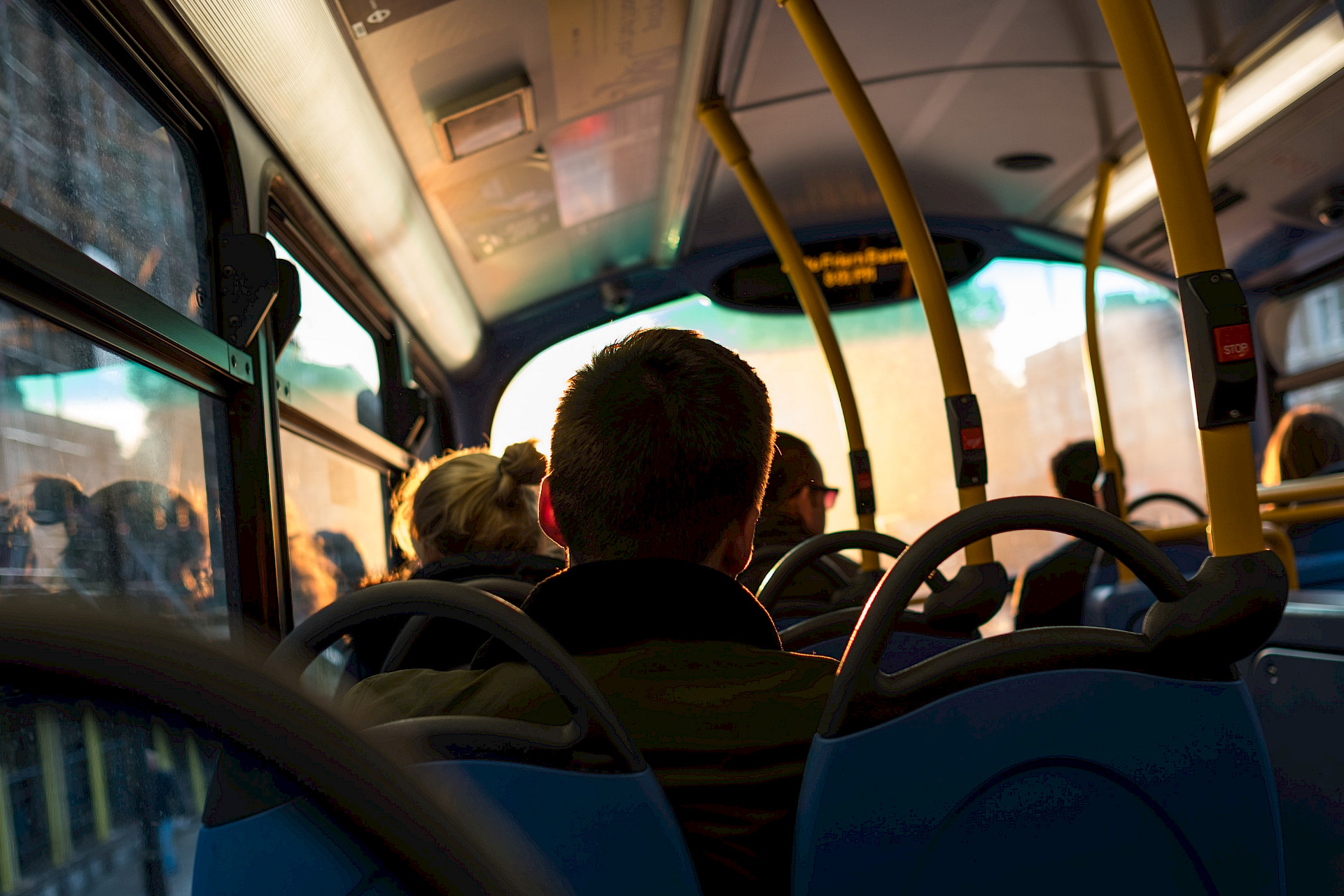
Since Thatcher, buses have put profit over passengers. But it doesn’t have to be this way.
The Cambridgeshire and Peterborough Mayor, Dr Nik Johnson, can bring buses into public control through a power called “franchising.” That’s how London runs its buses.
You’ve got a big opportunity to win public control RIGHT NOW. Over the next month, the Mayor is consulting on transport plans, including whether to use franchising.
Please use the consultation to tell him you want buses that work for people, not profit.
We've written a guide to help you make the case for public control. Open the consultation in a new window and scroll down and we'll walk you through it step by step - whether you've 1 minute or 5 minutes to spare.
Start your response to the consultation now
To send a clear message can take as little as 60 seconds (see Option 1 below). If you have more time, please answer a more questions to show them why you support public control (Option 2). Either way, please make sure you answer Question 5!
Option One: Takes just 60 seconds!
Just got 60 seconds? Answer Question 5 and then skip to the final page to fill in the required ‘About You’ section.
5. To what extent would you support or oppose the franchising of the local bus network by the Cambridgeshire & Peterborough Combined Authority?
Answer:
Strongly Support
Please then answer questions 20-33 in the final section ('About You') and the hit "submit!"
Option Two: 5 mins to increase your impact
Can you help have a bigger impact on the consultation? Here are some suggested answers for other questions to show the public’s support for franchising.
The Combined Authority might ignore responses to the consultation that look too similar. So your response needs to be in your own words wherever possible.
2. Do you have any comments on the proposals for:
Pick one of the following and re-write the evidence in your own words. Answers:
- Cheaper fares?
- I fear that to get everyone out of cars, the cheap fares must apply universally. However, this is not possible without shifting to franchising. According to the Centre for Cities, only franchising allows "Mayors to subsidise all fares."
- Even where some fares are made cheaper under the current system, it is bad value-for-money for local taxpayers.
- Currently, the money from ticket sales (called the farebox) is controlled by individual private companies.
- Once the funding to lower fares runs out, we have no guarantee that fares will stay low as operators are in charge.
- Lowering fares will hopefully increase the number of passengers. In turn, this should boost ticket sales. Any increase in the money from sales will be paid out as dividends by private companies.
- If the public is paying to lower the fares, we should get the return on the investment, not private companies.
- Under franchising in London, the farebox is controlled by the Mayor and so they get the return on investment when lowering fares boosts bus use. They can then reinvest this into the service. We should have franchising here too.
- More routes?
- I am concerned about promises to deliver more routes without a firm commitment to franchising.
- Under the current system of deregulation, private companies are prevented from cross-subsidising their quieter routes with the profits from busier services.
- That means that an essential hospital service could get cut under the current system but if the Mayor had a franchised bus system like London they could redistribute the profits to protect it.
- In Ipswich, the Council Leader could direct the publicly controlled buses to keep services on by running at zero profit.
- Fast, high frequency services?
- Under our current system there is nothing the Mayor can do to force bus companies to increase frequencies against their will, so I don't believe this will be possible without a London-style system.
- Ultimately, some roads are always going to be very profitable, so multiple companies put their buses on those streets.
- Those routes become overserved, with needlessly high frequencies, when other communities get just two buses a day.
- Under franchising, the Mayor controls the frequencies and could redistribute buses so they are used more efficiently.
- That would mean the Mayor could take excess buses on busy streets and send them to rural communities.
- Longer operating hours?
- Researchers found that franchising in London is more efficient in using public subsidies and costs the public less.
- Lots of early/late services are already supported by the public as the council awards "tenders" or contracts to bus companies to operate these services.
- Without a more efficient system, we will struggle to save enough money to deliver these longer operating hours.
- Increased rural services?
- Evidence shows that in City Regions outside London bus companies have profit-margins twice as high as in London.
- That reflects the fact that the money taken in ticket sales is controlled by the Mayor who reinvests it into the network.
- Here private companies can pay out the profits to their shareholders as dividends.
- If we franchise the bus network we could reinvest the profits on city routes to expand the network in rural areas.
- Simpler ticketing?
- For tickets to really feel simple we need a single, unified set of fares across the entire region and across buses.
- At the moment, each individual bus company has to offer its own fares to avoid breaching competition law.
- In London, there is a single, best-value ticket on offer that caps your daily spend across all the operators.
- Transport experts say this can only be legally provided through franchising.
- I don't think your plans for simpler ticketing can deliver what the public expect unless you use franchising.
- Zero emission bus services?
- For buses to best meet the public's needs, we should have a say in how they are designed.
- However, under current plans the buses would be owned by the operators who would commission the designs on their terms, not in the interests of passengers.
- In Greater Manchester and Liverpool, where plans for franchising are going ahead, the fleets will be publicly owned.
- This means they are designed to meet the accessibility, integration (e.g., spaces for bikes) and parenting (e.g., wheelchair spaces) needs of the community. This is only possible if we move to franchising.
3. Are there any additional improvements to bus services that would be needed for you to use bus services for more of your journeys?
The scheme currently fails to address one of the biggest issues that stop people using the bus: unreliability. Please raise this issue in your answer and pick one of the pieces of evidence below and write it in your own words.
Answer (in your own words):
I would like buses to be more reliable. Too many of the services I rely on do not turn up on time at all.
Pick one piece of evidence:
- Buses in public ownership are more reliable. Every year the Government releases a list of local authorities ranked by how reliable their buses are. Last year, the four areas in England that have publicly owned buses (Blackpool, Nottingham, Reading, & Warrington) were in the top ten for reliability. Blackpool has been in the top ten every year for the last decade. Last year, Cambridgeshire was the 14th most unreliable!
- Franchising means more relialistic timetables. Research into the human rights impacts of privatisation and deregulation of buses by the former UN Special Rapporteur on Extreme Poverty found that drivers "found in many cases bad scheduling, and people asked to drive a vehicle and it was physically impossible to do those routes at those times on those days" as companies put drivers under "pressure to work on impossible margins." Under franchising, decisions about timetables are made by the local authority who would be able to set more realisitic timetables so that vehicles turn up on time.
- Franchising means more reliable vehicles. Franchising can set minimum standards for vehicles, including stating that they cannot be beyond a certain age. Old vehicles are more likely to break down and cause delays.
- Franchising means a greater guarantee of reliability. Researchers have found that before deregulation and privatisation, more drivers and buses were kept on standby to take over routes if there was a problem. These drivers, called "spares," were ready at a moments notice to hop in a vehicle at a depot and get to where another vehicle has broken down so that passengers can be guaranteed a service. These have been lost as private companies saw the "spares" as an unnecessary cost. Franchising could specify that spares must be employed.
- Franchising can stop the driver shortages. One of the reasons for the current high level of cuts is because too many drivers are leaving the bus industry. This means that there aren't enough drivers to run the advertised services. Drivers are leaving because of low pay and poor working conditions (e.g., no/limited comfort breaks). Under franchising, the Mayor can specify that pay and conditions for drivers can't fall below a certain floor. This will help stop the shortages.
- Franchising can make cancellations fairer. At the moment, when there aren't enough buses or drivers to run a services, the decision about what service to cut falls to individual operators. They have a duty to maximise their profits to their shareholders. They will prioritise keeping more profitable routes, which already have higher frequencies, running. They then choose to cancel less frequent rural or suburban routes leaving communities with 2 or 3 hour gaps between services. Under franchising, the Mayor can specify that where cancellations are necessary, they must protect rural communities, not profits.
5. To what extent would you support or oppose the franchising of the local bus network by the Cambridgeshire & Peterborough Combined Authority?
Answer:
Strongly Support
8. Do you have any comments on the proposal to introduce a Sustainable Travel Zone?
Answer (in your owns words):
- While introducing road charging to support public transport may be appropriate, I don't think it is sensible to bring this in before franchising our buses.
- Only when buses are franchised can the Mayor redeploy all of the money raised through the sustainable travel zone straight into improving buses without having to give the money to private operators.
- Under the current system, the private companies would control any profits from improvements the public's investment from the travel zone money generated. They would be obliged to pay this out to shareholders overseas.
- The place where road charging has been used successfully is Nottingham. Nottingham Council owns the local bus company and so people paying the charge know all their money stays in the local economy.
18. Taking into account the improvements suggested above, are there any additional measures that would help enhance or address impacts on you?
Answer (in your own words):
- I would like buses and public transport to be more accountable to my community.
- At the moment, whenever I raise an issue the company or local authority pass the buck and point their fingers at each other.
- Under franchising, the decisions about our services would be made by elected representatives who are accountable to me and the needs of businesses, families and groups in my community.
- The system would also be integrated and coordinated centrally, not by a patchwork of different operators and local councils, making it easier to hold the network to account.
Please complete questions 20-33 in the “About You” section.
Thank you for completing this survey! Please share it with your friends.
Share on TwitterShare on FacebookShare on WhatsappShare on Email