
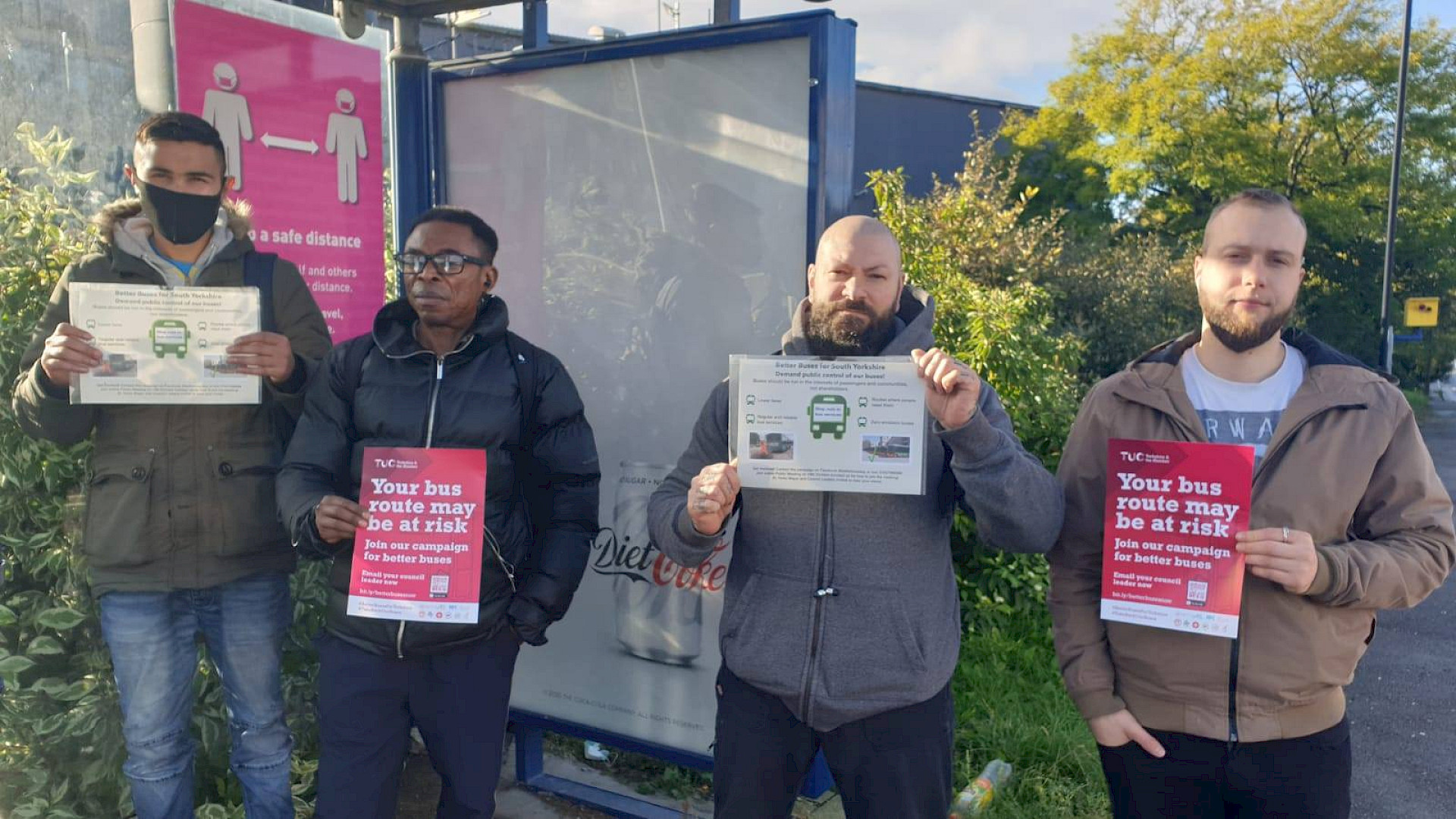
Your buses should work for you. It's really that simple.
The more people like you that submit a response disagreeing with the proposed partnership, the hard it will be for South Yorkshire's leaders to justify leaving private companies in charge of YOUR buses.
Please click below to start the consultation and respond to the multiple-choice questions as described below.
Start your response to the consultation now
4. To what extent, if at all, do you support the vision and ambition set out in the Plan for how we want to transform the bus network in South Yorkshire?
Answer: Neither Agree Nor Disagree
6. To what extent, if at all, do you agree or disagree with our long term focus being on improvements to improve bus reliability, to make sure that the buses, bus stops and our interchanges offer a better experience to users and that we should move towards a cleaner and greener fleet?
Answer: Strongly Disagree
8. To what extent, if at all, do you agree or disagree with our proposed approach to making bus fares and ticketing more simple and more affordable?
Answer: Strongly Disagree
10. To what extent, if at all, do you agree or disagree with the our proposed approach to creating more frequent and reliable bus services?
Answer: Strongly Disagree
12. To what extent, if at all, do you agree or disagree with our proposed approach to delivering a better bus experience?
Answer: Strongly Disagree
14. To what extent, if at all, do you agree or disagree with our focus on delivering a net zero emission bus fleet by 2040?
Answer: Strongly Disagree
16. The main objective of the Enhanced Partnership and Scheme is to secure additional resources and to deliver improvements to bus services across South Yorkshire. Do you agree that the Enhanced Partnership will achieve this?
Answer: Strongly Disagree
17. Why do you say this?
The main aim of any reform to local buses should be to deliver a green public service that addresses the needs of our communities. Please highlight this point in your own words. Feel free to adapt one of the examples below or adapt earlier points not used already.
-
No action on network expansion. The limited frequency and destinations of current bus networks are the top two reasons more people don't use the bus (TransportFocus). Only public control allows the mayor to expand the network by using the profits from the busiest routes to cross-subsidise services that are currently quieter.
-
Experts agree: a partnership can't deliver the best possible bus network. According to independent researchers at Transport for a Quality Life, 11 out of 16 essential attributes of a 'World-Class Bus System' cannot be achieved under a partnership (the remaining 5 can only be 'partially achieved'). Franchising fully- or partially-achieves them all. The Government's assessment said that partnerships may only "be able to achieve [Local Transport Authority] objective[s] in some circumstances" whereas franchising was "likely to effectively achieve the objective in all circumstances." Finally, the Centre for Cities described enhanced partnership working as a "fudge which stops mayors from delivering the quality bus networks their electorate rightly expect.”
-
Securing additional resources. This enhanced partnership, which leaves private operators in charge of the network, is a political choice, not the only way to secure funding. The West Yorkshire Combined Authority wrote that "The National Bus Strategy sets out two bus reform options; Enhanced Partnership and Franchising, both of which will secure future bus funding." This was confirmed by the Department for Transport which said that "From April 2022, LTAs will need to have an Enhanced Partnership in place, or be following the statutory process to decide whether to implement a franchising scheme, in order to receive the new discretionary schemes of bus funding." Clearly, public control would allow South Yorkshire to gain funding too. Why is it pursuing the inferior partnership option?
-
Partnerships will bleed the region dry. Under partnerships, investment is public but the profits are privatised. This will see any additional funding from Westminster leave the region as dividends. First Bus has already committed to its shareholders that the Government's bus policy, which pushes local councils into partnerships, will "raise [profit] margins to 10%" and "supports regular dividends commencing in 2022 [the year partnerships will be established]." If we are to reap the benefits of improving services, we need a positive cycle where returns on public investment are put back into public services. This only begins to be possible under public control, as the money from ticket sales is in public hands.
18. Finally, are there any comments you would like to make about the proposals set out in the Enhanced Partnership Plan and Scheme, or any other matter raised in this consultation?
Pick one option and describe it in your own words.
-
Our Buses? Our Say. At the end of the day, the final decision about bus services should be with local people, not remote and wealthy shareholders. As highlighted by the Centre for Cities, any positive change that may occur in a partnership is "ultimately dependent on operators" and decisions remain "in the hands of operators." The profit motive will always clash with the public interest. Only public control, and beyond that public ownership, will deliver the green public service run by and for local people.
-
One-Shot Wonder? Partnerships rely on local authorities and national government investing in a small number of service improvements, thus creating a short-term increase in ridership and ticket sales for operators. In return for the profits this generates for their shareholders, private bus operators promise some short-term improvements. Partnerships only last a fixed term. Once the Authority has built a decent network of bus lanes and bus shelters, it will have a weaker hand in future partnership negotiations. When the next lot of route cuts or price hikes are proposed, what will the Authority have to persuade operators to abandon their plans?
-
Bad Track Record. Partnerships have been employed for over 30 years in attempts to improve services. They have consistently failed to deliver long-term improvements in services or ridership. This includes South Yorkshire where bus companies routinely act in bad faith — to the frustration of local leaders. Former UN Human Rights lawyers have called for them to be "phased out."
Thank you for taking part in this consultation!