Capita is a multinational outsourcing business listed on the London Stock Exchange. Its major shareholders are mostly investment and asset management funds.

The total amount the NHS spent on private firms has increased in five of the last six years. While the NHS spent £9.6 billion on private firms in 2019, it spent £14.1 billion in 2025.
New research by the Centre for Health and the Public Interest (CHPI) shows private firms made £1.6 billion in profits from NHS contracts in 2024/25.
We Own It’s research shows that, between January 2012 and May 2024, at least £90.1 billion out of the NHS’s budget went to private firms. Based on profit margin estimates from public sector contracts specialists, Tussell, we calculate that at least £3 billion of this £90.1 billion was taken out in profit.
Below is a top 7 list of private companies with big NHS contracts expiring by the next general election in 2029, which the government must end and bring back in-house when they expire:
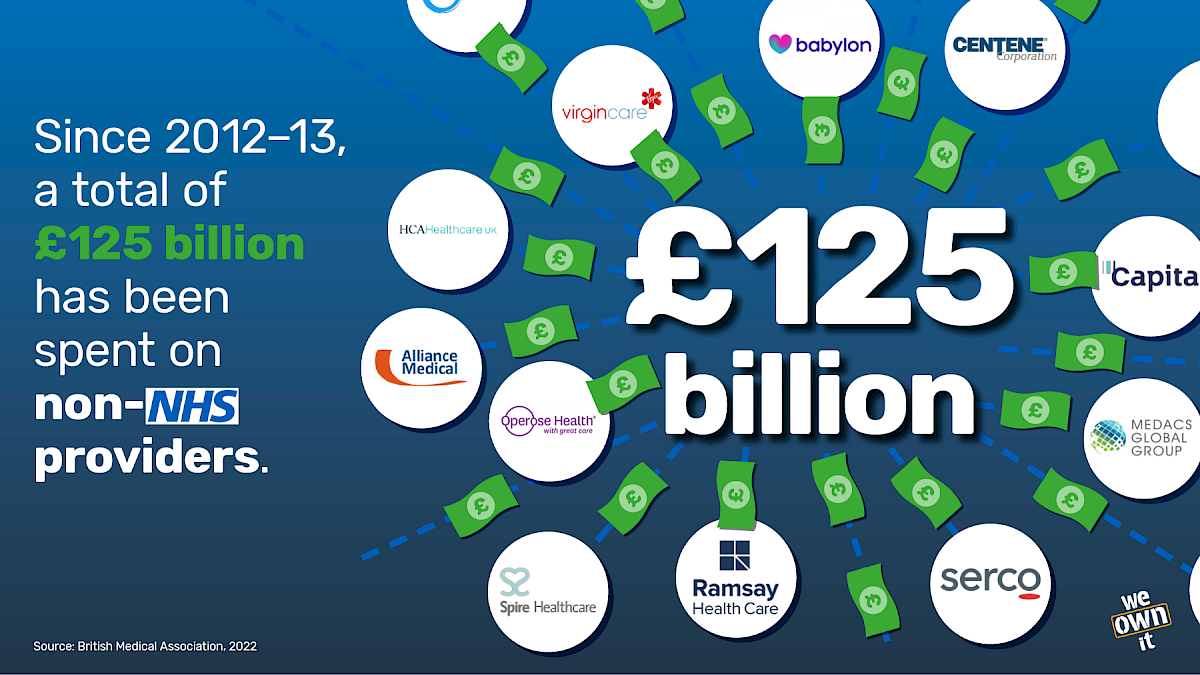
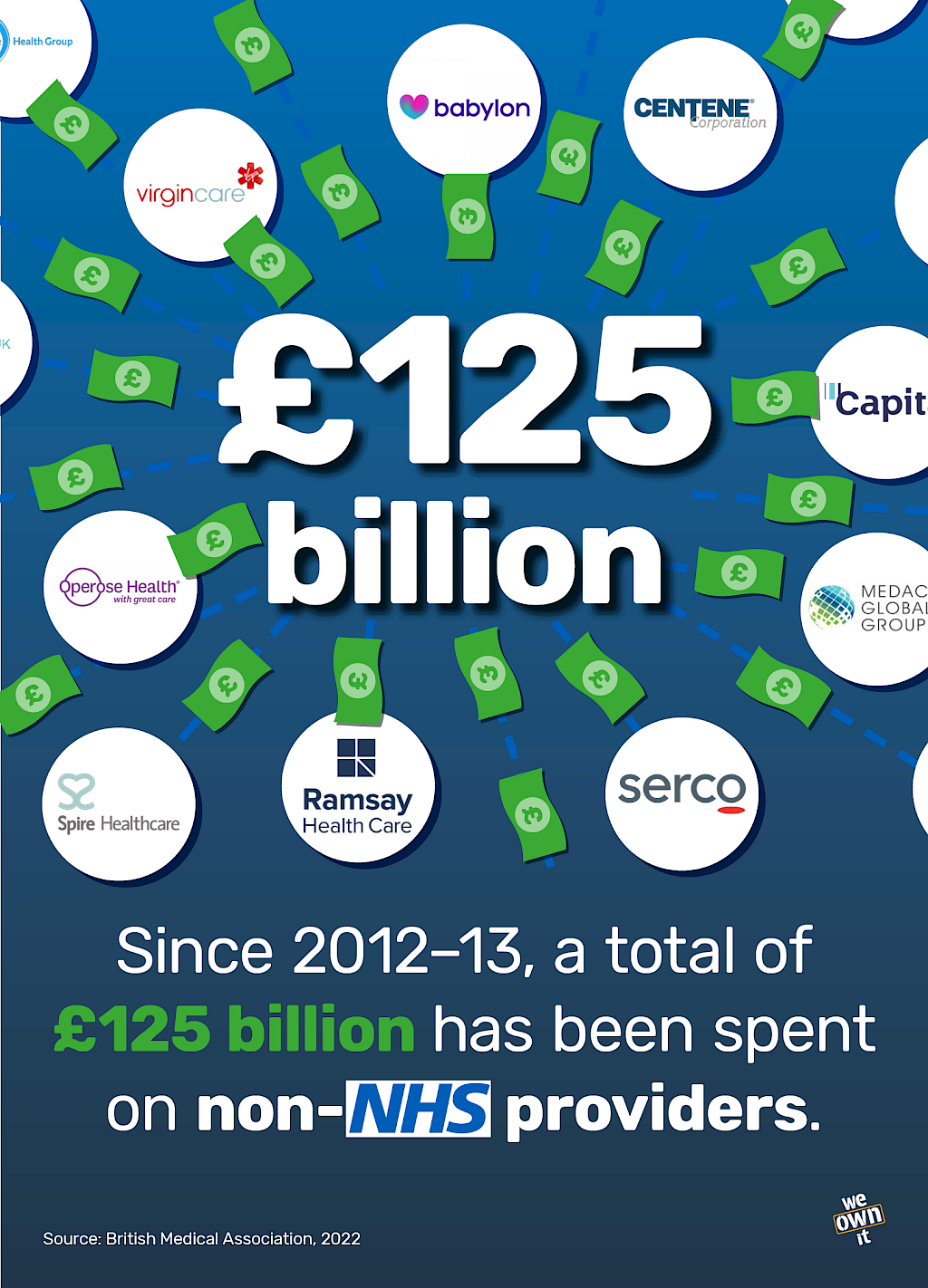
In 1990, an internal market was established in the NHS - decision-making about services was separated from providing care (known as the 'purchaser-provider split'). A 2014 analysis by the Centre for Health and the Public Interest (CHPI) suggests the additional administration costs of the purchaser-provider split to the NHS were at least £4.5 billion a year.
The 2012 Health and Social Care Act required NHS Trusts to put out contracts for services to competitive tendering, including private companies. The 2022 Health and Care Act repealed this requirement, but did not require NHS Trusts to give priority to NHS bodies. This opens the door to private firms getting NHS contracts without a tendering process.
Oxford University research suggests that NHS privatisation is linked with preventable deaths. Their analysis linked outsourcing to 557 excess deaths between 2013 and 2020.
NHS privatisation has been further expanded by Labour in 2024. The National Choice Framework, updated in October 2024, requires GPs and other primary care providers to offer patients options of “any provider which holds an NHS contract to provide this service, including some independent providers who deliver services for the NHS”.
Private Finance Initiatives (PFI) are another way that private companies have been brought into the NHS. Under PFI, private firms borrow to build NHS facilities, with NHS trusts paying them back under contracts lasting 30 years or more. PFI was banned by the Conservatives in 2018, but the Labour government is now looking to bring back PFI for building new Neighbourhood Health Centres.
Read more about privatisation of the NHS and what we're doing to stop it.










Capita is a multinational outsourcing business listed on the London Stock Exchange. Its major shareholders are mostly investment and asset management funds.
Centene Corporation is an American healthcare company based in Missouri and listed on the New York Stock Exchange.
Circle is owned by the US company Centene Corporation.
Deloitte is one the world’s big four multinational accountancy/consultancy groups. It is a UK private company limited by guarantee.

Optum is a subsidiary of the American company UnitedHealth Group, which is listed on the New York Stock Exchange and mostly owned by institutional investors.

As of 2021, data company Palantir was 60% owned by individual investors and 24% by institutions. Founder Peter Thiel owns 7% of shares while CEO Alexander Karp owns 2%.
PricewaterhouseCoopers is a global accounting and consultancy firm, with a network of companies across the world.

According to the NHS Support Federation, Sciensus is a subsidiary of Halcyon Topco. Over 75% Halcyon’s shares are owned by Vitruvian Partners, a European private equity firm.

Serco is a multinational outsourcing company that is listed on the London Stock Exchange. Its biggest shareholders are investment and asset management firms.
Unipart is majority owned by its employees.